Unpredictability tests school leadership but also reveals it. We all recognize there’s political turbulence, fluctuating enrollment and funding and uncertainty.
Superintendents and boards are facing difficult choices. Remain calm. You are fully equipped to navigate through this successfully.
We’ve spent the summer on the road in a wide variety of districts and have found that the most effective leaders in these uncertain conditions are disciplined about three habits:
Clarity, choice, and courage. You’ll see some examples of each throughout this article.
Have you ever sat down to do a large jigsaw puzzle? At first glance, it’s overwhelming: scattered pieces and no clear structure. Everything looks alike as you take the pieces out of the box.
But seasoned puzzle-solvers know the secret: you start with the edges. Build the border first. Lock in what’s clear. Then, look for visual anchors: small clusters, repeating patterns, places where the picture starts to come into focus.
The three Cs—clarity, choice, and courage—are those anchoring steps for strategic leaders. They help you frame the work, avoid forcing the wrong pieces into the wrong spots, and gradually reveal the full picture.
They don’t promise instant completion. But they do offer a way forward that’s calm, coherent and ultimately satisfying.
Let’s break it down, so we can build it up.
Clarity: Start with what’s true
Clarity doesn’t mean certainty. It means being honest about what’s known, what’s suspected and what’s still unknown, and then explicitly naming those knowns and unknowns.
Too often, budget crises trigger sweeping declarations that feel strong in the moment but tend to unravel as exceptions pile up. Examples of this include suspending all travel, cutting school supplies or even freezing vacancies.
These demonstrative stances signal that leaders are reacting rather than reasoning. The inevitable exceptions lead to broken trust with staff, families and, worse, your board.
Clarity requires disciplined analysis of the entire system, not just the financial picture. That’s where the SCIP framework comes in: systems, culture, instruction and people. Use it to examine where pressures are showing up, where alignment is breaking down and where your team’s time and attention are truly going.
Ask:
- Are our systems built for flexibility or are we locking ourselves into outdated ways of working?
- What signals is our culture sending to staff right now: trust, confidence or confusion?
- Are we protecting core instructional priorities for students or just doing business as usual?
- Do we treat our people as assets and contributors or just ‘FTE’s?
Systems, culture, instruction, and people form the frame that holds everything else in place. Without that border, the rest of the puzzle floats and so does your leadership strategy. Build the edges first, then move inward.
In FY26, clarity also means carefully measuring value. We’ve been encouraging districts to rigorously look for LOI: learning on investment. LOI shifts the focus to outcomes that matter for kids. It asks not only “What did we spend?,” but more importantly, “What did students learn with that investment?”
As one district CFO recently told us, “We no longer ask, ‘What’s the cheapest program?’ We ask, ‘What gets kids learning, and is it worth the cost?’”
In Guilford County Schools, Superintendent Dr. Whitney Oakley faced federal funding delays that threatened critical programs. She responded by speaking directly with her community and North Carolina state policymakers about what was known, what remained uncertain and the potential consequences of funding not coming through.
Her message stayed consistent and grounded in student impact and building trust, even among those who were focused on cutting spending.
“These funds help us support teacher and principal growth and development, instructional support and critical safety programs,” Oakley said. “We could spend the next 10 to 12 months evaluating how these funds align with priorities, but pausing something in the middle of the summer when we’re about to start school is going to negatively impact students.”
Choices: Focus the work of school leadership
Once district leaders gain clarity, they face a more uncomfortable task: making choices.
As resources shrink, everything will feel essential. But leadership means being honest about tradeoffs.
We’ve seen well-intentioned leaders try to preserve every position, every program and every promise. This approach sends mixed signals to staff already stretched thin. And, frankly, it implies that cost savings won’t be needed: the wrong message during uncertain times.
We’ve also seen courageous leaders conduct annual or quarterly community assessments on the changing needs in schools. This creates a dynamic budgeting and LOI process that is lock-step with boards and stakeholders.
In Everett, Washington, Superintendent Ian Saltzman faced a FY24 budget cut of 10%—nearly $28 million. He responded by quickly convening a series of stakeholder engagement sessions to bring the community into the decision-making.
Teachers, school leaders, parents, union representatives and others participated in facilitated role-alike meetings. In each session, participants wrestled with tradeoffs and were asked to prioritize what mattered most for students.
The process didn’t make the cuts painless, but it gave the district a transparent, shared framework for the choices ahead. On a 5-0 vote, the board adopted a budget that reduced headcount by 140 positions, resulting in 25 layoffs.
Reflecting on the process, Saltzman said: “This is a very challenging time for everybody and every district. We wanted to get out early. We felt it was the right thing to do for our system.”
This is the moment to decide what your district stands for. What must be foundational, even if budgets shrink? What can be paused or scaled back?
What can be better targeted or focused? Where can responsibilities be redistributed? Which supports can shift from the central office to schools, or vice versa?
The key is to link every major investment (or cut) to an explicitly identified need and stated goal, using LOI as the equalizer. Is the initiative improving academic outcomes, supporting teachers effectively or accelerating equity?
Do we have accurate data or a line-of-sight into the impact benefits of an initiative? If not, can the dollars or the staff time be better used elsewhere?
This work isn’t just about spreadsheets. It’s about strategic alignment and execution.
One of our favorite exercises is to lay out a district’s full spending plan and ask: Do we fully understand how each investment contributes to a measurable learning outcome? If the answer is no or unclear, it’s time to reconsider.
Not every puzzle piece fits everywhere, even when you’re sure you know where it goes. We’ve watched leaders hang on to programs, roles or practices simply because they’ve always been there.
But in a puzzle, trying to jam a piece into the wrong spot wastes time and sometimes damages the puzzle. Strategic leadership in FY26 means letting go of what doesn’t fit the picture anymore, even if it once did.
Courage: Lead when it’s hard
Clarity and choice set the strategy. Courage is what sustains it. You can do hard things.
And your courage will be tested. Loud voices will demand rapid action or reaction to the news of the day.
Board members may push unilateral motions. Parent groups will fight to preserve beloved programs. Staff will be afraid of losing their jobs or their support. Social media will amplify every rumor.
What leaders say and do during these moments matters deeply. The most respected superintendents don’t posture. They lead with transparency, empathy, and discipline.
They say: “We’ve heard your concerns. We’ve reviewed the data. And here’s the decision we’re making because it aligns with our values and our vision. These are the upsides and the downsides that we’re already planning for. This is where your needs fit in and how we will honor the best path forward.”
They acknowledge pain. They repeat key messages consistently. And when they don’t know something, they say so.
In Anchorage, both state and federal funding instability put district priorities at risk for FY26. Superintendent Jharrett Bryantt responded with a steady message about the stakes, combining urgent communication with decisive action.
Bryantt reports, “This summer reminded me that real leadership is about staying grounded when the ground keeps shifting. In Anchorage, we urgently communicated the stakes of instability, at both the state and federal levels, and we acted. That meant using every tool available to protect students, from legal action to direct advocacy.
“Our efforts weren’t about making noise. We stayed laser-focused on making meaningful progress. While others debated, my team kept preparing classrooms, supporting teachers and preserving the programs families rely on. And we were never alone. Our school board stood firm in its priorities and our community raised its voice when it mattered most.
“The result was restored funding and, more importantly, restored stability. Now our job is to protect that progress and build a stronger foundation for the future, so students aren’t left vulnerable the next time external forces threaten public education.”
Don’t try to lead alone. Courage means letting others in, especially your leadership team.
Uncertainty can accelerate distributed leadership if intentionally managed. When principals, teacher leaders and even students are part of the planning process, the resulting decisions are stronger and more sustainable.
Every puzzle has a moment where you feel stuck. But that’s not a reason to stop; it’s a reason to zoom out. Sometimes, inviting another set of eyes or simply shifting focus to a different corner helps everything click into place.
Courage in leadership works the same way. Don’t try to muscle through alone. Share the “picture on the box.” Let others help you build the puzzle.
This too shall pass
Let’s remember: this is a cycle.
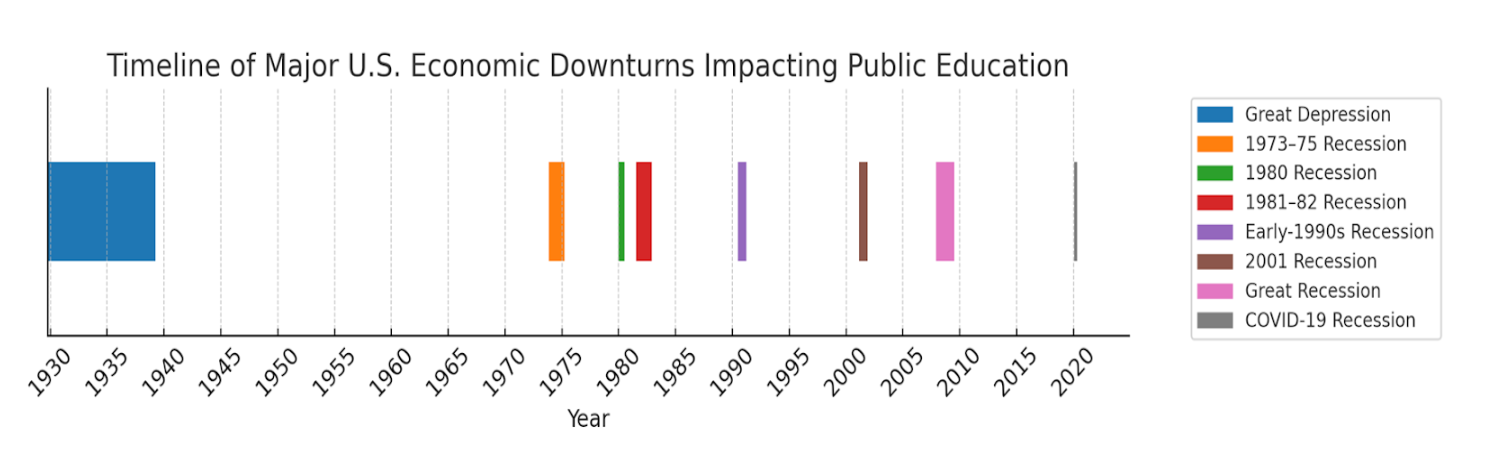 We’ve shown district leaders a simple economic chart labeled only with one word: Cyclical. It lands every time. Yes, recessions come. But so do recoveries.
Districts that lead well now will be first in line for reinvestment later, armed with stronger systems, clearer priorities and more trust.
In fact, many of the districts we admire most today got there by navigating past downturns well. They:
- Improved their strategic communication and engagement with families and the community
- Reorganized teams to focus on instruction
- Used budget constraints to clarify roles & responsibilities
- Built stronger board governance practices
- Improved internal feedback loops and change management
- Through trust, created a healthier, more connected leadership culture
If you’re a retiring superintendent, be bold in setting the system up for the next leader. If you’re a new superintendent, be clear with your board and community that this is a time for courage.
And when the next upturn comes (and it always does), the districts who’ve done the methodical work are the ones who can scale with confidence.
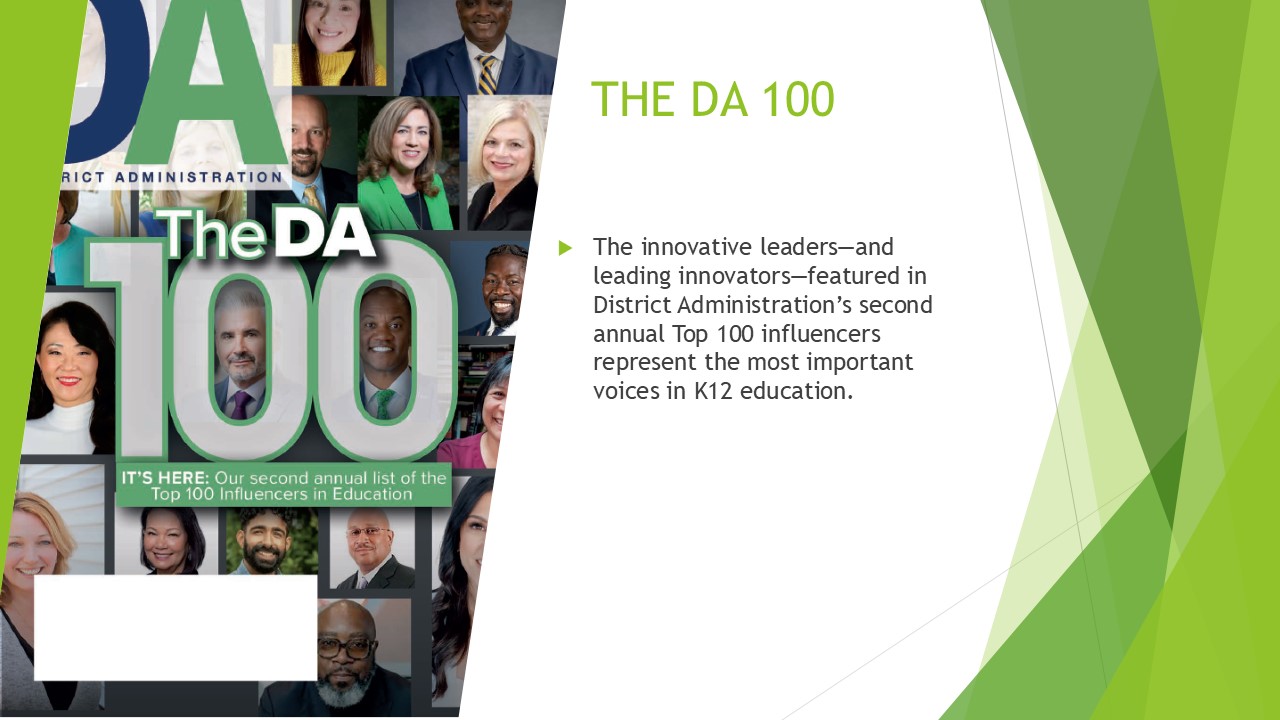
The DA 100: Innovative leaders and leading innovators
Find your next story in our slideshow