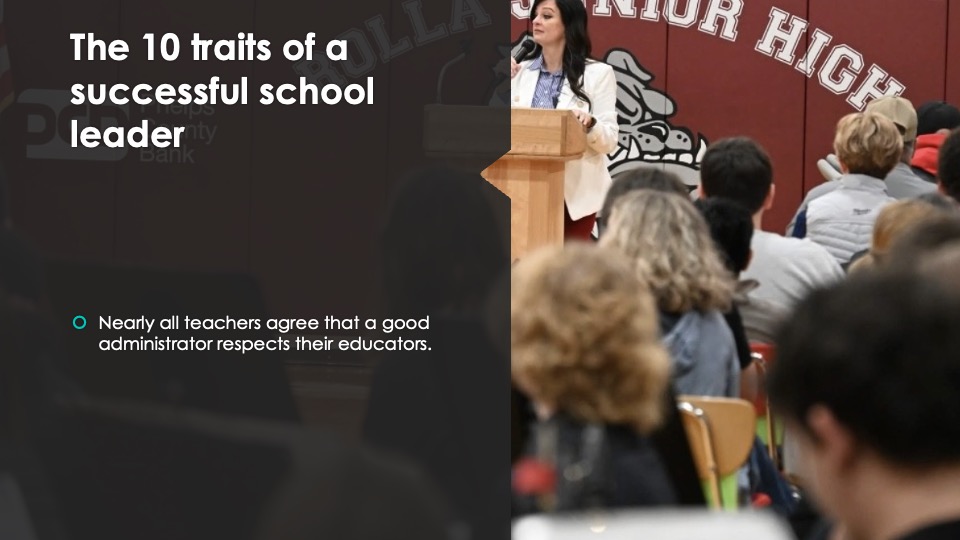
Nearly all teachers agree that a good administrator respects their educators. Becoming an encouraging, people-driven leader is a skill that can be learned, says Principal Dr. Tori Snitker of Rolla Junior High School.
Snitker, for her doctoral dissertation, asked teachers in three neighboring districts to identify the 10 characteristics of a school administrator that have the biggest impact on school climate. Reflecting on her early career as a teacher, Snitker says educators want to feel valued because, if they feel otherwise, they take those feelings home.
“Those teachers carry that stress to their children and their spouses, because that’s who they’re going to vent to,” she explains.
Those interactions also bleed into the rest of the school day, dampening teachers’ effectiveness to provide quality instruction, she adds.
“It’s very stressful, any time I’ve had some type of conflict with my administrator when I was in the classroom,” Snitker says. “It really colored my world.”
All of the educators whom Snitker surveyed said showing respect for teachers was the most valuable trait for an administrator. Respect, therefore, is a priority she instills in any administrator she mentors.
Teachers also value leaders who are:
- Dependable when important decisions or serious issues arise
- Able to interact positively with teachers and students
- Supportive when difficult situations arise in the lives of teachers, students and staff
- Trustworthy
- Able to establish strong lines of communication with teachers, staff and students.
- Positive role models
- Honest and transparent
- Visible to staff, teachers and students during the school day
- Empathetic to the needs of teachers, staff and students
Bringing her research to life
Snitker says she tries to embody those 10 characteristics every day. Snitker regularly visits classrooms with the assistant principal and school resource officer to inquire about teachers’ needs.
“I’m never looking into how they’re teaching,” she says. “I have my observations at a separate time. Our daily pop-ins are all about making sure that we get to visit with the teacher and ask if they need anything.”
Most importantly, the other leaders in her building buy into the compassion-driven mindset. Servant leadership, Snitker says, drives high teacher retention in her school.
“We put out a lot of anonymous surveys about me and my assistant principal’s performance, and we have received a lot of high scores,” she says. “We also receive a lot of comments saying how they’re appreciative of how we handle things, how we take time to visit with them and how we have their best interest in mind.”
Administrators who don’t give teachers the support they deserve are not prioritizing student success.
“What happens to your teachers feeds into the classroom,” she reiterates.
Servant leadership is a learned skill
Snitker hopes every principal possesses the 10 leadership characteristics underscored in her research. She notes that every leader varies in capacity, and compassion and the other traits can be learned.
“You can become better at any stage in life,” she says. “You can become a better listener. You can become more empathetic. You can become a better communicator. That comes through reflection, research and collaborating with someone who does those things well.”
More from DA: How one principal is generating CTE excitement