Rachel Edoho-Eket, Ed.D., a Maryland principal, aims to help educators build some of their soft skills amid the edtech innovations at FETC 2026.

Edoho-Eket, a featured speaker on the FETC 2026 Leadership Track, will cover sustainable self-care, family engagement and mentoring in a series of presentations at the Future of Education Technology Conference in January.
Her focus on self-care and setting work-life boundaries stems from the burnout she experienced as a new principal during the COVID pandemic.
“I did not want to leave public education because my heart is with and always going to be with education,” says Edoho-Eket, who leads Waterloo Elementary School in the Howard County Public School System. “But if I was going to sustain myself, I had to make some specific shifts.”
She encourages other leaders to do their work during designated work hours, even as they’re pulled in multiple directions, and become aware of how much work they’re bringing home. Leaders can then make the necessary shifts in their work schedules so they can accomplish tasks during the school day.
“If I’m going to observe a teacher for 60 minutes, I’m going to block off 90 minutes on my calendar to see the teacher’s full lesson and do that 30-minute write-up while it’s fresh on my mind,” she explains. “That saves me time on the back end, not having to spend 30 to 40 minutes at home when I could be with my husband and children.”
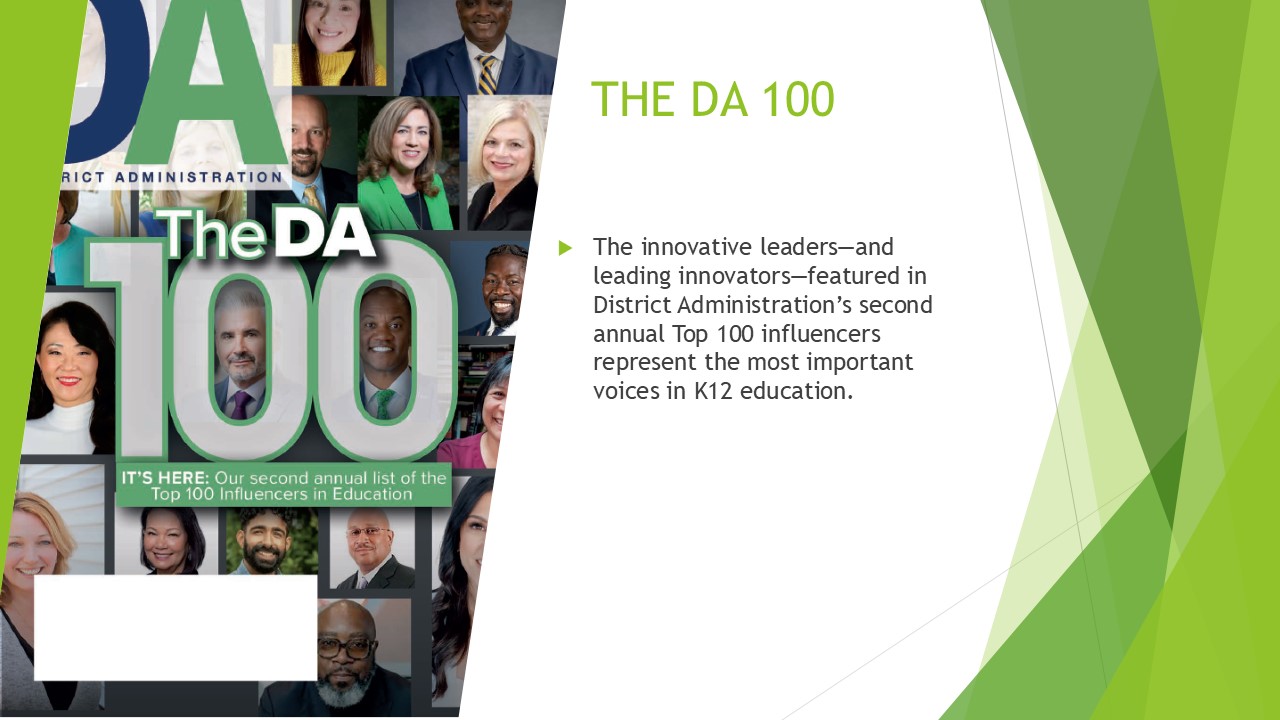
Since reassessing her time, she adds, she has written two books and embarked on a speaking career while she and her husband have guided their children into high school. She was also named The DA 100 top education influencers for 2025.
Who did we lift up?
Another skill she has been honing since COVID is communication, and tailoring her outreach to the channels preferred by families. She and her leadership team still make phone calls and send emails, but now they text and video message families with help from an automated translation app.
“Some families have not had the best experiences with education and that anxiety and anger is real,” she says. “So we have to do some messaging with families just to make sure that they know that school is a place where we’re here to support their child, that we care about their children and that we care about them.”
She has also learned the value of being both a mentee and a mentor during her career in K12. She said she was more than content teaching kindergarten when a mentor recognized her potential to move into a building leadership position.
She believes part of a principal’s job is to talent-spot teachers with leadership potential and help them develop their skills. “We already know that there’s a pipeline issue for teachers, and there’s a bigger pipeline issue for leaders,” she contends. “A lot of teachers, if you ask them, ‘Do you want to be a principal? Do you want to be an assistant principal?’ Their answer is, ‘No.’ That was my first answer.”
She encourages leaders to gradually give teachers more responsibility as, for instance, department heads or team leaders, before considering a role as an assistant principal or principal.
“We can ask people what they are passionate about, and then give them more opportunities to do it,” she concludes. “That’s how you develop great leaders, and growing other leaders is our legacy. Who did we lift up into more leadership?”
Looking Forward to FETC 2026: Change management strategies for IT leaders
Find your next story in our slideshow