Educators are increasingly turning to artificial intelligence to save time—whether drafting lesson plans, generating activities or analyzing student data. But time saved doesn’t always mean learning gained.
If AI is going to truly improve teaching and learning, it must build on the curriculum, assessments and resources school districts have already invested in—not work around them.
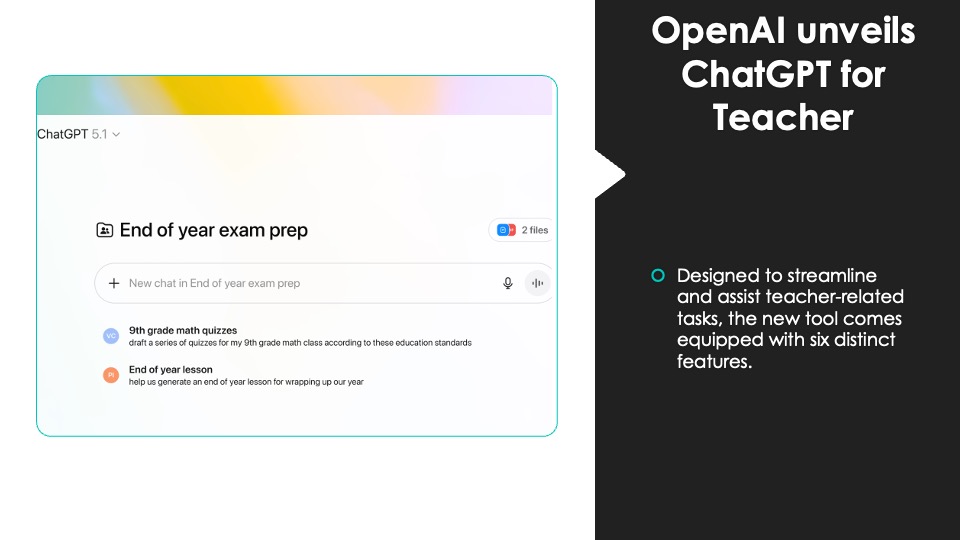
Today, one of the most common uses of AI in schools is generating lesson plans aligned to state learning standards. It’s easy to see the appeal: type in a standard and a prompt, then watch ideas generate instantly.
But when lesson planning becomes this automatic, teachers risk losing the reflection and professional judgment that make instruction meaningful and effective.
For example, a teacher might type, “Create a week-long lesson plan on adding fractions with common denominators for 4th grade aligned to state standards,” and instantly receive a ready-to-use plan. The efficiency is undeniable—teachers save valuable time on planning and formatting.
But the AI doesn’t know what’s already been taught, where students are in the district’s scope and sequence or how individual learners are progressing. Without that instructional context, the plan may appear polished but miss opportunities for deeper learning.
It’s a trade-off—time saved versus teaching impact—and the challenge ahead is designing AI tools that preserve both.
‘Instructional slop’
There are already early warning signs of what happens when the balance tips too far toward efficiency. A recent MIT Media Lab study found students who relied heavily on AI writing tools showed lower neural connectivity, weaker memory and less ownership of their work. When AI does too much of the thinking, learners think less deeply.
The same danger exists for teaching: if AI takes over too much of lesson design, we risk ending up with “AI instructional slop”—instruction that looks aligned on paper but lacks intentionality and human insight.
Districts invest in core curriculum for a reason: it provides coherence and purpose. Strong curriculum is designed by subject matter experts who author content first for learning goals and then align to standards for consistency and rigor.
AI tools often reverse that process. They start from the standards and generate lessons backward, and in the process, slip into “teaching to the test” rather than teaching for understanding.
Districts are being inundated with new tools, adding to an already crowded edtech landscape. Combined with the fact that most teacher-facing AI tools operate as standalone products rather than interoperable systems, this places additional strain on both IT teams and educators.
There’s currently no seamless way to connect these tools to the systems districts already rely on for curriculum, assessment and student data. As a result, teachers often find themselves copy-pasting information between systems in order to make AI tools more useful within their instructional context.
When AI is integrated
Core curriculum providers are in a unique position to bridge the gap between teacher productivity and instructional quality. By embedding AI directly into the tools teachers already use, they can offer smart support within existing workflows—no more juggling prompts, tabs or copy-pasting.
When AI is integrated into a district’s ecosystem, it can help personalize instruction for all students, draw on assessment data and flag students who need extra support. In this model, AI enhances what already works instead of producing disconnected materials in isolation.
Curriculum providers also bring a critical advantage: quality control. They continuously update content to reflect evolving standards and instructional research, while large language models rely on static datasets that may miss these shifts.
For instance, as the Science of Reading reshapes literacy instruction, a generic AI might still generate lessons rooted in outdated approaches. Providers who understand these nuances can build safeguards that keep instruction evidence-based and aligned to current practice.
Moreover, curriculum alignment rarely matches 100% with every state’s standards, and teachers often spend valuable time bridging those gaps manually. AI could help streamline this process by spotting gaps in alignment, as well as suggesting targeted adjustments to reduce the alignment burden on teachers while preserving the integrity of the core materials.
Independent organizations like EdReports could play a role here too, expanding their review frameworks to evaluate how AI embedded within curriculum supports teacher reflection and productivity while protecting against shallow, machine-generated content.
Extending the reach of teachers
In the near future, core curriculum could become truly adaptive through the integration of an AI-powered teacher copilot—a tool embedded within the curriculum and drawing on existing district data to support each student more effectively.
For instance, if a child has been chronically absent, the system could automatically adjust lessons to help them catch up using the same vetted materials the district has already adopted. Or a teacher could simply ask the copilot to merge two lessons after an unexpected snow day, maintaining continuity without losing instructional intent.
When AI is connected to the systems and materials districts already rely on, it extends the reach of high-quality instruction, saving teachers time while preserving coherence, consistency and meaningful learning for every student.