Better Data Practice, Better Student Outcomes
 At a time when helping students succeed in their paths to college and career is more critical than ever, fewer than 40% of leaders say they use data on postsecondary advising, application, or enrollment.
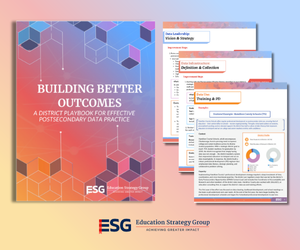
The Building Better Outcomes Playbook—a free resource for district leaders from Education Strategy Group—was borne directly from conversations with leaders from 50+ districts about these issues. It offers a powerful roadmap grounded in real-world examples, actionable tools, and a deep understanding of the challenges districts of all sizes face when it comes to using data to drive their students’ long-term success.
The Playbook can help district leaders address many of their most pressing data challenges in direct pursuit of better postsecondary outcomes for their students.
Challenge: Unclear Data Vision
Districts need a clear and coherent vision for how data use will help them achieve their overarching goals for long-term student success.
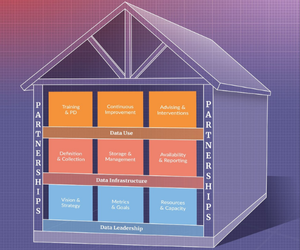
Solution: The Playbook’s Vision & Strategy module guides district leaders through the process of explicitly and consistently centering postsecondary and workforce success for all students in the district’s mission, vision, and strategic plan.
Challenge: Confusing Metrics
Conflicting definitions of “college and career readiness” and other metrics can lead to confusion and make it nearly impossible to compare outcomes or make strategic decisions.
Solution: The Definition & Collection module helps districts co-develop clear, technical definitions for each postsecondary metric. It guides teams through stakeholder engagement, documentation of discrepancies, and alignment with state data standards.
Challenge: Limited Capacity
Even the most well-intentioned strategies falter without the right people and resources.
- Solution: The Resources & Capacity module provides staffing models, budgeting strategies, and partnership frameworks to build sustainable capacity. It includes sample job descriptions, organizational charts, and tools for conducting gap analyses.
Challenge: Fragmented Systems
Siloed data systems make it difficult for educators to access the information they need to support students effectively.
- Solution: The Availability & Reporting module helps districts design user-centered dashboards and reporting tools that unify data across systems.
Challenge: Low Data Literacy
Even with good data systems, many educators lack the training to interpret and use data effectively, meaning dashboards go underutilized and insights remain untapped.
- Solution: The Training & PD module offers a framework for role-specific training, onboarding, and retraining.
Challenge: Continuous Improvement
Data must be part of a larger cycle of reflection and action. Without structured review processes, districts risk using data reactively rather than proactively.
- Solution: The Continuous Improvement module outlines a year-round cadence for data review, root cause analysis, and action planning.
These and other modules serves as “building blocks” of the Playbook; each is designed to answer the big questions we heard from practitioners and includes:
 Postsecondary Priority Metrics: Specific data points districts should track and create strategies to improve in order to drive better long-term outcomes for students.
- Standards: Descriptions of the components of “high quality” practice for each building block to help districts assess their current practice.
- Examples: Real stories of how a district and/or district partner has achieved high-quality practice in its local context.
- Improvement Steps: Step-by-step actions districts can take to improve data practice – with written guidance, editable tools, and additional examples to support and illustrate each step.
The Building Better Outcomes Playbook is not just a set of tools—it’s a strategic framework built on years of research, fieldwork, and collaboration with districts across the country.
It meets you where you are—whether you’re just beginning to define metrics or ready to launch a district-wide dashboard—and helps you build the systems, capacity, and culture needed to support every student’s journey beyond high school.